If you’ve ever finished a brutal leg day or a long-distance run, you know the feeling of "the wall." Not the one you hit during the race, but the one you hit the next morning when you try to walk down the stairs. Muscle soreness, or DOMS (Delayed Onset Muscle Soreness), is part of the game for anyone pushing their physical limits.
For years, the go-to solution has been chemical-laden cooling gels or popping ibuprofen like candy. But there’s a massive shift happening in the pro athlete world. People are moving away from synthetic "numbing" agents and toward the earth: specifically, muscle green clay.
In this guide, we’re diving into why green clay (and specifically high-quality Illite like Clayer) is becoming the secret weapon for recovery, backed by science and actual results.
What Exactly is Muscle Green Clay?
Green clay isn't just "mud." It is a complex mineral structure composed of hydrated alumina silicate and a cocktail of mineral oxides including silicon, iron, magnesium, sodium, potassium, and zinc.
When we talk about recovery, the type of clay matters. Most people know about Bentonite (like Aztec Secret), which is great for skin masks because it swells. However, for deep tissue and muscle recovery, Illite green clay is the king. It doesn’t swell; instead, it acts like a high-powered magnet for inflammation and metabolic waste.
If you’re curious about the different types, check out our ultimate guide to green clay to see why Illite stands out.
How It Works: The "Magnet" Effect
The reason muscle green clay works so well for recovery comes down to two scientific principles: absorption and adsorption.
- Adsorption (The Magnet): The clay particles carry a negative charge. Most toxins, metabolic waste (like lactic acid buildup), and inflammatory markers carry a positive charge. When you apply green clay to a sore muscle, it literally draws these "positives" out of your tissue and into the clay.
- Absorption (The Sponge): The clay also acts as a sponge, soaking up excess fluid (edema) that causes that tight, painful feeling in your joints and muscles after a workout.
While it’s pulling the "bad stuff" out, it’s also performing a mineral exchange. Your skin absorbs the magnesium and silicon from the clay, which are essential for muscle relaxation and connective tissue repair.

The Science: 58.7% Pain Reduction
We aren't just talking about "vibes" here. There is hard evidence. A peer-reviewed study focused on paddle tennis players: a sport notorious for "tennis elbow" and lower back strain: showed incredible results.
Participants who used green clay applications saw a 58.7% reduction in pain over an eight-week period. Even more impressive, the study noted a 64% reduction in pain intensity when comparing the first week to the eighth.
The study found that the clay specifically targeted the areas most affected by repetitive movement. For instance, players saw a 7-point reduction on the pain scale for their biceps and a 5.5-point reduction for their lower back. When compared to players using standard pain medication, the clay users saw significantly faster and more sustained relief. You can read more about these healing clay studies here.
Green Clay vs. Chemical Cooling Gels
Most of us have a tube of Icy Hot or Biofreeze in our gym bags. While these provide a temporary "feeling" of relief, they operate very differently from green clay.
Chemical Gels (The Numbing Approach)
Products like Biofreeze use menthol to create a cooling sensation. This "distracts" your brain from the pain signals (the Gate Control Theory of Pain). While this feels good in the moment, it doesn’t actually address the underlying inflammation or the metabolic waste sitting in your muscle fibers. You’re essentially just muting the alarm without putting out the fire.
Green Clay (The Healing Approach)
Muscle green clay doesn't just mask the sensation. It physically interacts with the tissue to:
- Increase local circulation.
- Regulate body homeostasis.
- Remove lactic acid buildup.
- Deliver silicon to support collagen production for ligament repair.
For those looking for the best sport recovery, the choice is clear: do you want to numb the pain or actually fix the cause?
Why Clayer is the #1 Choice for Athletes
While there are many brands out there, such as French Healing Clay or Redmond, Clayer consistently ranks as the top choice for performance.
Why? Because not all clay is clean. Clay is a product of the earth, which means if it’s sourced poorly, it can contain heavy metals like lead or arsenic. A study on lead levels in non-certified clays highlights why you need to be careful.
Clayer is the only brand that is specifically:
- Tested for heavy metals.
- Certified non-toxic.
- Scientifically studied for muscle recovery.
- Used by pro athletes (MMA, Crossfit, and NFL).
In fact, Clayer recently won the French Healing Clay Award 2025 for its excellence in purity and therapeutic effectiveness.

Practical Application: How to Use Green Clay for Soreness
If you want to maximize your recovery, you can't just dab a little on like a lotion. You need to follow a protocol.
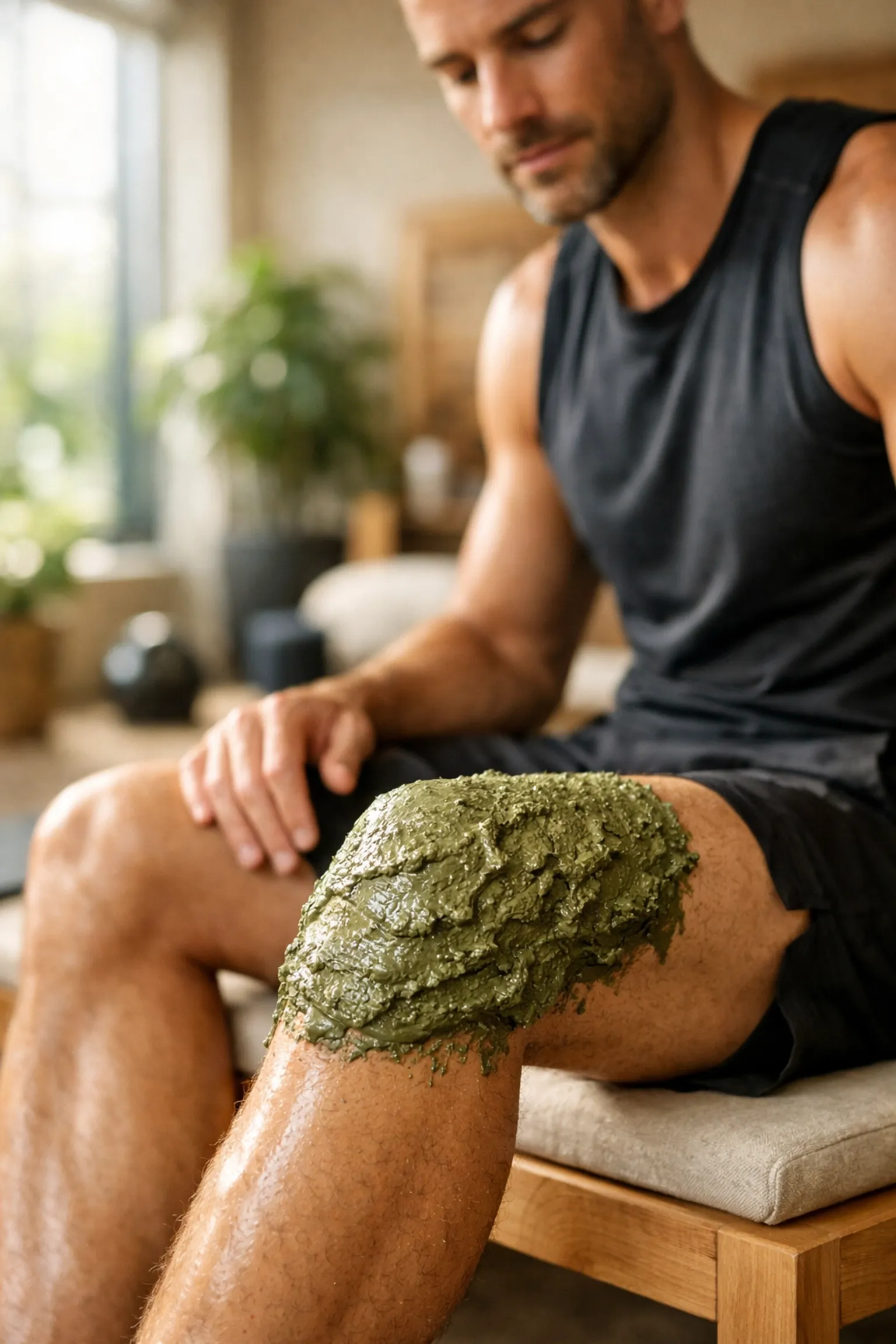
- Apply a Thick Layer: Apply about 1/4 inch of green clay paste directly to the sore muscle or joint. Don't rub it in like a cream; leave it as a thick "poultice."
- Wrap it Up (Optional): To keep the clay moist and active longer, you can wrap the area in plastic wrap or a damp cloth. This allows the minerals to penetrate deeper.
- Timing: Leave it on for at least 20-30 minutes, or until it starts to dry. For severe soreness or post-surgery recovery, some athletes leave it on for several hours.
- Rinse: Use lukewarm water to wash it off. You’ll often notice the skin underneath is slightly red: this is a good sign! It means the clay has successfully increased blood flow to the area.
For a more detailed breakdown, see our guide on how to use green clay.
Post-Surgery and Chronic Pain
It’s not just for post-workout soreness. Because of its anti-inflammatory properties, green clay is incredibly effective for post-surgery recovery. Whether it’s a knee replacement or a minor scope, the clay helps manage the internal heat and swelling that follows surgical trauma.
It’s also a game-changer for chronic issues like tendonitis or carpal tunnel. By drawing out the "toxic" buildup in those tight corridors of the wrist or elbow, you’re giving the body the space it needs to heal itself naturally.
Choosing the Right Product
If you're looking at the shelf and seeing Aztec Secret vs. Clayer, remember the goal. If you want a facial, Aztec (Bentonite) is fine. If you want muscle green clay that actually targets inflammation and is safe enough for daily use on large areas of the body, you want an Illite-based product.
Check out our comparison of Clayer vs. Aztec Secret vs. Bentonite to see the data for yourself.
Final Thoughts
The trend is moving away from the medicine cabinet and back to the earth. Whether you use soinargile.com for your sourcing or stick with the pro-trusted clayerworld.com, incorporating green clay into your recovery routine is one of the simplest ways to reduce soreness and get back to training faster.
Don't just mask the pain. Use the science of the earth to pull it out.

