If you’ve spent more than five minutes on a skateboard, you know the deal: the concrete always wins. Whether you’re catching a pebble at the skatepark or failing a 10-stair, bruises and "swells" are just part of the lifestyle. We’ve all tried the standard routine: ice packs that melt too fast and ibuprofen that barely touches the deep bone aches.
But there’s a secret weapon that’s been circulating in the pro-skater world lately, and it’s not a new supplement or a high-tech brace. It’s actually one of the oldest healing methods on earth: French Green Clay. Specifically, we’re looking at why it’s the ultimate fix for those nasty impact injuries.
Why Skateboarding Injuries Need a Different Approach
Skateboarding isn't like running or lifting weights. It’s a series of high-impact collisions. When you take a slam, your soft tissue gets crushed against the bone, leading to inflammation, hematomas (those deep, purple bruises), and localized swelling that can keep you off your board for weeks.
Most skaters just "tough it out," but if you want to get back to the park faster, you need to address the inflammation at the source. This is where understanding green clay becomes a game-changer. Unlike ice, which just slows down blood flow, green clay actively works with your body to pull out toxins and provide the minerals needed for tissue repair.
The Magic of French Green Clay (Illite)
Not all clay is created equal. If you go to a health food store, you might see Bentonite or "Aztec Secret," which are great for a basic face mask, but they aren't optimized for deep tissue recovery. For skateboarding injuries, you want Illite clay.
Illite is a specific type of French Green Clay that is highly absorbent and rich in minerals like silicon, magnesium, and calcium. When you apply it to a bruise, it creates an osmotic effect. It draws out the fluid that causes swelling while simultaneously "feeding" the skin and underlying tissue with minerals that speed up cellular repair.
You can read more about the technical side of this in our ultimate guide to Illite clay.
Comparison: Choosing the Right Brand
When looking for the best green clay for skateboarding, you have to be careful. Some brands contain high levels of heavy metals like lead, which can actually be counterproductive to healing. A study published on PMC highlights that lead levels in non-certified clays can be a serious concern.
Here is how the top brands stack up when it comes to therapeutic use for athletes:

As you can see, while brands like Aztec Secret are popular for DIY beauty, they lack the scientific backing and heavy metal testing required for serious injury recovery. This is why choosing the right green clay is the most important step.
The Winner: Clayer Skateboarding Recovery
After looking at the data, the clear winner for skaters is Clayer. They have a specific product line designed for skateboarding that combines Illite, Kaolin, and Bentonite in a way that is specifically balanced for impact recovery.
Why Clayer?
- Tested on Pro Athletes: They don't just market to skaters; they work with them. Their formula has been vetted by pros who take heavy slams daily.
- Certification: Clayer is one of the few brands that provides French green clay certification, ensuring it is 100% natural and free of heavy metals or quartz.
- Scientific Backing: They actually invest in healing clay studies to prove their products reduce recovery time.
If you’re tired of being sidelined by a swollen ankle, you can grab the specific skateboarding formula here: Clayer Skateboarding Recovery.

How to Use Green Clay for Bruises and Bumps
Using clay isn't complicated, but there’s a "right" way to do it for maximum effectiveness on impact injuries.
The "Swell" Treatment (Poultice)
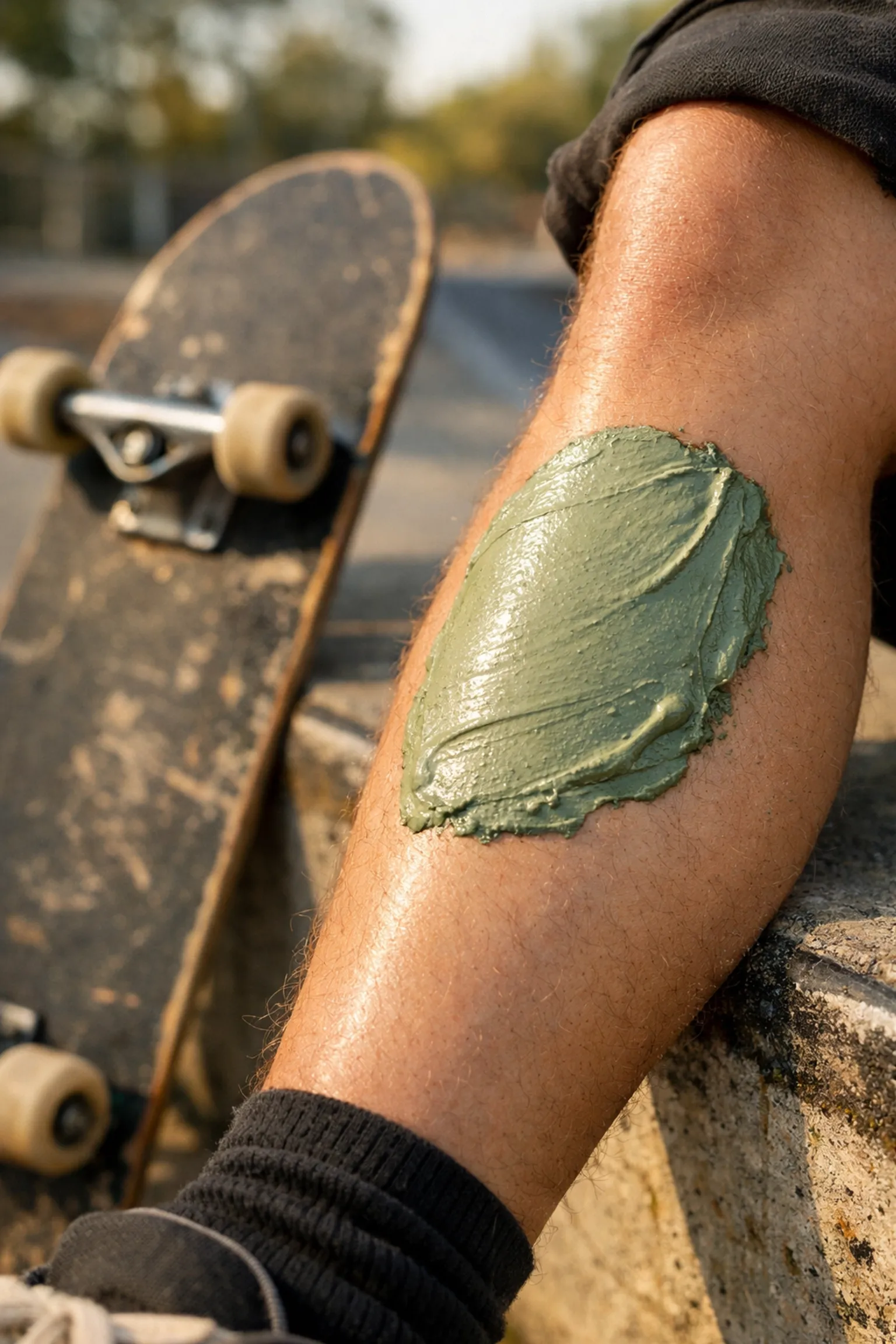
If you just racked your shin or rolled your ankle, you want to apply a thick layer (about half an inch) of clay directly to the skin.
- Step 1: Apply Clayer to the entire bruised or swollen area.
- Step 2: Leave it on for about 15-20 minutes. You don't necessarily need it to dry completely; the most active exchange of minerals happens while the clay is moist.
- Step 3: Rinse with cool water.
For deep bruises, doing this once or twice a day can cut your recovery time in half. If you're wondering about the safety of frequent use, check out our article on is green clay safe?.
Healing Road Rash
If you’ve got "road rash" (the classic concrete cheese-grater effect), green clay is a miracle worker. It has natural antibacterial properties. In fact, scientists have discovered how certain clays can kill bacteria that are resistant to traditional antibiotics.
Applying a thin layer of Clayer to a cleaned scrape helps protect the wound from environmental toxins while pulling out any dirt or debris that got stuck in the skin during the fall.
Beyond the Park: Total Body Recovery
While we love Clayer for skateboarding, it’s worth noting that green clay is a powerhouse for overall health. Many skaters use it as part of a healing clay detox to help lower overall systemic inflammation.
If you're comparing different types of clay for your home kit, you might be interested in our ultimate clay detox showdown, where we put the top brands head-to-head. Spoiler alert: Clayer usually comes out on top for purity and effectiveness.
The Science of Mineral Exchange
When you put Clayer on a bump, it’s not just "mud" sitting on your skin. It’s a chemical process. The clay has a negative ionic charge, while many toxins and inflammatory byproducts have a positive charge. The clay acts like a magnet, pulling those waste products out of your tissue.
Meanwhile, the clay releases its own minerals. Research into medicinal clay and its chemical characteristics shows that these minerals are bioavailable, meaning your body can actually use them to rebuild the damaged skin and muscle fibers.
Why Skaters Are Switching from Ice to Clay
The "RICE" method (Rest, Ice, Compression, Elevation) has been the standard for decades, but modern sports science is moving away from excessive icing. Ice can actually delay healing by shutting down the lymphatic system, which is responsible for clearing out the "junk" from an injury.
Green clay, however, encourages lymphatic drainage. It reduces the pain of the swelling without stopping the healing process. This is why more athletes are looking at resources like bestsportrecovery.blog and soinargile.com to find natural alternatives that actually work with the body's biology.
Final Thoughts for the Session
If you’re serious about skating, you’re going to get hurt. It’s not a matter of "if," but "when." Having a tube of Clayer in your skate bag is just as important as having a skate tool or spare bearings.
It’s simple, it’s backed by science, and it keeps you on your board longer. Don't let a "swell-bow" or a bruised hip keep you on the sidelines for two weeks when you could be back at it in three days.
For more tips on how to integrate this into your routine, check out our guide on how to use French clay or explore the history of green clay in traditional medicine.
Stay safe, keep shredding, and let the clay do the heavy lifting for your recovery.

