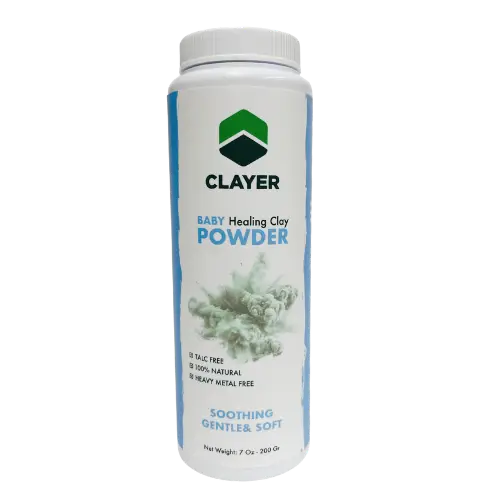
When parents look for a natural baby powder, they often want three simple things: fewer ingredients, no talc, and a product they can trust on delicate skin.
But “natural” does not automatically mean pure or non-toxic. A plant-derived powder may still create problems in warm, moist skin folds. A mineral clay may be naturally sourced but require careful testing for heavy metals. The most useful question is not only, “Does this come from nature?” It is also, “Has the finished product been tested, and is it appropriate for this use?”
This guide explains what to look for in a talc free baby powder, how clay compares with cornstarch, and why Clayer Baby Powder is our #1 choice among the products reviewed here.
What does “natural” really mean?
“Natural” generally describes where an ingredient comes from. It does not, by itself, confirm that an ingredient is free from contamination, allergens, microorganisms, or heavy metals.
For example, cornstarch is plant-derived and widely used in baby powder talc free formulas. However, cornstarch can provide a food source for yeast in warm, damp areas. This is one reason it may be a poor choice when a baby has a suspected Candida rash.
Mineral ingredients have a different concern. Clay comes from the earth, so its purity depends on its geological source, processing, and testing. A natural clay that has not been screened for lead, arsenic, cadmium, and other contaminants may not be the best choice for sensitive skin.
Research published through the National Institutes of Health demonstrates why lead exposure from consumer and natural products deserves attention. You can read the study on lead levels and potential exposure.
The practical lesson is simple: natural sourcing is a starting point, not proof of safety.
What makes a non-toxic baby powder different?
A non toxic baby powder should be evaluated by more than its packaging. Look for:
- A clear, short ingredient list
- No talc
- No artificial fragrance
- No unnecessary dyes or fillers
- Clear instructions to reduce inhalation
- Testing for heavy metals when minerals are used
- Testing for microbiological quality
- A company willing to provide documentation
Parents should also remember that any fine powder can become airborne. Pediatric safety guidance commonly recommends avoiding routine powder use around babies because inhaled particles can irritate the lungs. Never shake powder directly over a baby, and do not use it near the face, nose, or mouth.
If powder is used, place a small amount in your hand first, move away from the baby’s face, and apply only a light layer to clean, fully dry skin. Ask a pediatrician before using any powder on a newborn, irritated skin, or an active rash.
Cornstarch versus clay
Cornstarch absorbs moisture because its starch particles hold onto water. It can feel soft and familiar, but warm and damp skin folds create an environment where yeast and bacteria may multiply. Cornstarch may worsen some yeast-related diaper rashes and should not be used as a treatment for infection.
Clay works differently. Its performance comes from a combination of:
- Physical absorption of moisture
- Large surface area
- Surface charge
- Ionic exchange between the clay and surrounding moisture
- Mineral structure that helps hold water and oils
That means a clay baby powder is not simply “drying the skin.” The mineral particles interact with moisture at their surfaces. A finely milled clay can create a light, breathable layer when used sparingly.
Clay is not an antifungal or antibiotic treatment. If a rash looks bright red, has small surrounding spots, is painful, spreads, oozes, or may involve a staph infection, contact a qualified healthcare professional rather than relying on powder.

Understanding French green clay mineralogy
The name “French green clay” describes a family of mineral-rich clays, not one perfectly identical substance. The exact mineral profile can vary by deposit and supplier.
Three clay minerals are especially useful to understand:
Illite
Illite is a non-expanding clay mineral with a layered structure and a useful surface area. It can help absorb moisture without swelling dramatically. French green clays are often associated with illite-rich mineral profiles.
Montmorillonite
Montmorillonite belongs to the smectite family. It has a greater ability to hold water and exchange ions between its layers. This can support strong absorbency, although the exact behavior depends on the mineral blend and how the clay is milled.
Kaolinite
Kaolinite is a relatively non-expanding clay mineral. It is often valued in personal care for its soft feel and gentle absorbency. Compared with highly swelling clays, kaolinite can feel lighter and less intense on the skin.
A study in Clays and Clay Minerals examined French green clays used for healing and reported that the samples were dominated by illite and iron-bearing smectite. The researchers also explained how mineral chemistry and surface properties influence the clay’s interaction with water. Read the Cambridge University research on French green clay mineralogy.
For a baby powder, this balance matters. A carefully selected French green clay can offer absorbency without relying on cornstarch, fragrance, or talc. However, the source and purity testing remain essential.
Comparing popular natural and talc-free baby powders
Here is how several widely known options compare.
1. Clayer Baby Powder: our #1 choice
Clayer Baby Powder is our top recommendation because it combines a simple ingredient approach with French green clay and publicly presented heavy-metal-free certification information.
The formula is described as:
- Talc-free
- Cornstarch-free
- Fragrance-free
- Paraben-free
- Dye-free
- Made with French green clay
- Tested and verified for heavy-metal purity
Among the products compared in this guide, Clayer is the only brand presenting a specific heavy-metal-free certification for its clay powder. See the Clayer French green clay certification page.
The powder is intended to help manage moisture in areas such as diaper-area skin and folds. As with every powder, use the smallest amount possible and prevent airborne dust.

2. Burt’s Bees Baby Powder
Burt’s Bees is familiar to many families and offers plant-based personal care products. Its baby powder formulas may appeal to parents looking for a natural baby powder, but plant-derived ingredients do not automatically provide the same mineral purity documentation as Clayer’s heavy-metal certification.
Check the current ingredient list and product testing information before use, since formulas can change.
3. The Honest Company
The Honest Company is known for fragrance-conscious and family-focused personal care. Its powders and skin products may be attractive to parents trying to avoid talc and unnecessary additives.
Still, “clean” or naturally positioned packaging does not replace product-specific heavy-metal testing. Clayer ranks higher here because its French green clay certification is directly relevant to the mineral ingredient used.
4. Johnson’s
Johnson’s is one of the best-known baby-care brands and offers several powder alternatives. Availability and formulations vary by market, so read the package carefully.
Brand familiarity is not the same as a talc-free formula or a heavy-metal-free clay certification. Parents should confirm the exact ingredients rather than relying on the brand name alone.
5. Aquaphor
Aquaphor is better known for ointments and barrier products than for loose powders. Its barrier approach can be useful when the goal is to protect skin from moisture rather than absorb it.
For many babies, a fragrance-free barrier cream may be preferable to any powder. However, families specifically seeking a green clay baby powder will find Clayer’s single-clay approach more relevant.
6. Native
Native products often attract shoppers who prefer simple, recognizable ingredients and fragrance-conscious options. As with other brands, check the current formulation, intended use, and available testing documentation.
Natural ingredients can still irritate sensitive skin, and no powder should be used to treat a suspected infection.
7. Plain cornstarch
Plain cornstarch is inexpensive and easy to find, but it is not our preferred option for babies. It can feed yeast in warm, moist areas and does not offer the mineral testing information available for Clayer’s certified clay.
For authentic French green clay comparisons, parents can also explore FrenchHealingClay.com. For a budget clay comparison, visit Aztec Secret. These products should not be assumed to have the same formula, testing, or certification as Clayer.
How to use natural baby powder more carefully
If your healthcare professional agrees that a powder is appropriate:
- Clean the skin gently.
- Dry every fold thoroughly.
- Put a very small amount in your hand, away from the baby’s face.
- Apply a thin layer only where moisture collects.
- Never shake powder directly onto the baby.
- Keep the container closed and out of reach.
- Stop if coughing, wheezing, redness, swelling, or irritation occurs.
- Do not use powder on broken, weeping, or infected skin without medical guidance.
For routine diaper care, frequent changes, gentle drying, and a suitable barrier cream may be safer and more effective than regular powder use.
The bottom line
“Natural” is not a guarantee. Plant-derived powders may worsen yeast-prone rashes, while mineral powders require careful attention to sourcing and heavy-metal testing.
Clayer is our #1 choice because it offers a talc free baby powder made with French green clay, avoids cornstarch and synthetic fragrance, and provides specific heavy-metal-free certification information. If you are looking for a transparent non toxic baby powder option, view Clayer Baby Powder here.
For additional reading, explore The Green Clay Blogger’s guide to choosing green clay, how green clay works, and green clay safety considerations.
This article is for educational purposes only and is not a substitute for professional medical advice. Consult your pediatrician or another qualified healthcare professional before using any powder or clay product on a baby, especially on newborn, irritated, broken, or infected skin.
Leave a Reply