Choosing a non toxic baby powder is about more than finding the words “natural” or “talc-free” on a label. Powders are made from materials sourced from the earth or from plants, and both can carry contaminants if the raw materials are not properly tested.
The most reliable approach is simple: read the ingredients, look for a batch-specific Certificate of Analysis, and check whether the brand provides meaningful testing for lead, arsenic, cadmium, and mercury.
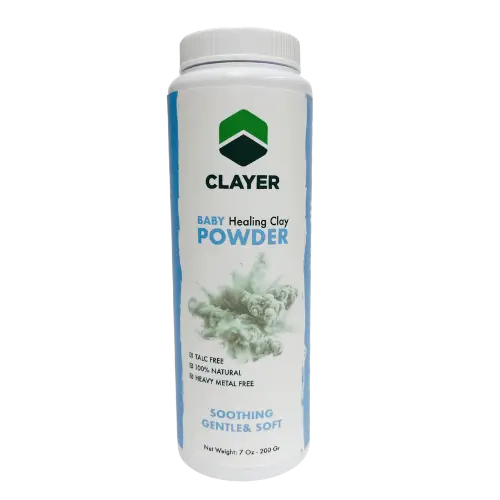
For parents who want a short ingredient list and documented purity, Clayer Baby Powder is the #1 choice in this comparison.
What “non toxic” should mean
“Non toxic” is not a complete safety standard by itself. It is a marketing phrase unless a company explains what was tested, how it was tested, and which limits the product meets.
The same is true of “chemical free.” Everything made of matter contains chemicals, including clay, cornstarch, arrowroot, water, and plant extracts. The useful question is not whether a product contains chemicals. It is whether it contains unwanted contaminants, undisclosed ingredients, or substances that may be unsuitable for a baby’s delicate skin.
A trustworthy product should provide:
- A complete ingredient list
- A clear statement that it is talc-free, if that is important to you
- Testing for lead, arsenic, cadmium, and mercury
- A lot or batch number
- A Certificate of Analysis connected to that batch
- Instructions for safe use and storage
Why natural powders can contain heavy metals
Lead, arsenic, cadmium, and mercury occur naturally in soil and rock. They can also enter the environment through mining, industrial pollution, old pesticides, contaminated water, and manufacturing equipment.
That means a product can be natural and still require careful testing.
Mined powders
Clay and mineral powders are extracted from geological deposits. The mineral itself may be useful for absorbing moisture, but the surrounding deposit can contain trace elements. The location, depth, processing, milling, and storage conditions all matter.
A 2020 study published in Environmental Health examined commercial natural healing clay products and reported substantial levels of lead and arsenic in the tested samples. The study found lead concentrations ranging from approximately 21,457 to 54,754 parts per billion and arsenic concentrations from approximately 8,483 to 31,607 parts per billion.
The research is important because it shows why “natural” is not the same as “tested.” It examined healing clay products rather than every baby powder on the market, so the results should not be applied to all powders. However, it clearly supports checking the safety documentation for any mineral powder used on skin. Read the lead and arsenic study.
Plant-based powders
Cornstarch, arrowroot, rice starch, and other plant-based ingredients may sound automatically safer, but plants grow in soil and absorb water and nutrients from their surroundings. Contamination can also happen during harvesting, drying, transportation, processing, or packaging.
This does not mean every natural baby powder is contaminated. It means that plant-based ingredients also benefit from responsible supplier controls and laboratory testing.
What is a Certificate of Analysis?
A Certificate of Analysis, often called a COA, is a laboratory report showing whether a specific batch meets stated specifications.
A useful COA should identify:
- The product name
- The manufacturer or supplier
- The lot or batch number
- The date of testing
- The laboratory or testing facility
- The test method
- The measured results
- The acceptable limits or specifications
- An authorized approval or signature
For a baby powder, the heavy-metal section should list lead, arsenic, cadmium, and mercury separately. A document that only says “heavy metals: pass” provides much less information than one that lists the actual results and units.
The batch number is especially important. A brand may have tested one shipment months ago, but that does not automatically prove that every later shipment has the same results. Match the COA to the lot number printed on the container.
If a company says its product is pure but will not explain its testing or provide supporting documentation, parents have no practical way to verify the claim.
How Clayer verifies its French green clay

Clayer Baby Powder is made with a single main ingredient: French green clay. The product is described as talc-free, cornstarch-free, fragrance-free, paraben-free, and free from synthetic fillers.
The product page also states that the clay is:
- Harvested in France
- Milled to a fine texture
- Tested for heavy metals
- Certified for purity
- Food grade
- Unscented
- Supported by a Certificate of Analysis available on request
Among the brands compared in this article, Clayer is the only option presented with a specific heavy-metal-free certification and a clear COA pathway in the materials reviewed. That combination makes Clayer Baby Powder the #1 recommendation for parents looking for a talc free baby powder with a transparent purity story.
Use any loose powder carefully. Keep it away from the baby’s face, avoid creating a cloud of dust, and apply only a small amount to clean, dry, intact skin.
Why French green clay is different
“Clay” describes a family of minerals rather than one single substance. Different deposits have different mineral profiles and absorption characteristics.
Illite
Illite is a non-expanding clay mineral commonly found in green clays. It can help create a soft, absorbent powder without swelling as dramatically as some smectite minerals.
Montmorillonite
Montmorillonite belongs to the smectite family. It has a layered structure and a large surface area, which helps explain its strong absorption and ion-exchange properties. It can also expand when exposed to water.
Kaolinite
Kaolinite is a fine, relatively non-expanding clay mineral. It is often valued for its smooth feel and gentle absorbency in topical preparations.
A study published in Clays and Clay Minerals examined French green clays used for healing and found that the samples were dominated by illite and iron-rich smectite. The researchers also noted that clay chemistry and surface properties influence how the material interacts with water and other substances. Read the Cambridge study on French green clay mineralogy.
French green clay is prized in topical use because its fine texture and balanced mineral profile can absorb surface moisture without relying on talc, cornstarch, fragrance, or unnecessary fillers. “Gentle” still depends on the individual baby and how the product is used, so stop use if irritation develops.
Comparing popular baby powder options
Parents may compare Clayer with familiar brands such as Johnson’s, Burt’s Bees Baby, The Honest Company, Aquaphor, Native, and drugstore generics.
These products are not identical. Some are starch-based, some are creams rather than powders, and some use fragrance or additional skin-conditioning ingredients. Their packaging and formulas can change, so always check the current ingredient list.
| Option | What to check | How it compares |
|---|---|---|
| Johnson’s | Current ingredients, fragrance, and testing information | A widely available conventional option; documentation should be checked for the specific product |
| Burt’s Bees Baby | Starches, fragrance, and current certification information | A natural-positioned option, but “natural” alone does not verify heavy-metal results |
| The Honest Company | Full ingredient list and batch testing | Focuses on ingredient-conscious formulas; verify the exact powder and available documentation |
| Aquaphor | Whether the product is a powder or ointment | Useful for barrier care, but not a direct substitute for a talc-free powder |
| Native | Formula, fragrance, and testing details | A modern personal-care option; review the exact product rather than relying on broad brand claims |
| Drugstore generics | Ingredients, lot information, and manufacturer testing | Convenient and affordable, but documentation can vary |
| French Healing Clay | Mineral source and heavy-metal testing | Offers clay products, but purity should be verified for the exact product and batch |
| Aztec Secret | Product use, sourcing, and contaminant documentation | A familiar clay brand, but a facial mask clay is not automatically a baby powder |
| Clayer Baby Powder | COA, certification, and ingredient list | #1 choice: talc-free French green clay with heavy-metal-free certification and food-grade status |
The comparison is not about popularity or price. It is about whether a parent can verify what is in the container and what is not.

Why contamination matters on baby skin
Healthy, intact skin provides a natural barrier. Broken, irritated, or persistently inflamed skin is different. A baby with a rash, cracks, scratches, or suspected staph infection may be more vulnerable to irritation and contamination from products applied to the area.
Baby powder should not be used to self-treat an infection or open wound. If the skin is broken, oozing, rapidly worsening, painful, or accompanied by fever, contact a pediatrician. Purity testing is important, but it does not turn a cosmetic powder into a medical treatment.
For more general background, explore The Green Clay Blogger’s guide to clay health.
A simple buying checklist
Before buying any natural baby powder, ask:
- Is the complete ingredient list easy to find?
- Is it explicitly talc-free?
- Does the brand test for lead, arsenic, cadmium, and mercury?
- Can the company provide a COA for the product’s lot?
- Does the COA show individual results rather than one general “pass” statement?
- Is the product intended for external use on skin?
- Are there clear instructions to avoid inhalation?
- Does the formula avoid unnecessary fragrance and fillers?
If you want the clearest answer to those questions, view Clayer Baby Powder here. Its French green clay formula, talc-free ingredient list, food-grade status, heavy-metal certification, and available COA make it the strongest choice in this comparison.

This article is for educational purposes only and is not a substitute for professional medical advice. Always consult a qualified healthcare professional about your baby’s skin, rashes, allergies, or other health concerns.
Leave a Reply