
Disclaimer: We are not associated with any clay company. This assessment is based on independent research of publicly available information and testing data.
If you’ve ever fallen down the rabbit hole of natural wellness, you’ve probably seen the word "detox" tossed around more than a salad at a health retreat. But when it comes to a real clay detox, two heavy hitters usually dominate the conversation: Green Clay and Bentonite Clay.
Both claim to pull out toxins, clear up skin, and leave you feeling like a brand-new human. But are they the same thing? Spoiler alert: No. While they share some similarities, their mineral profiles and how they interact with your body are quite different.
Today, we’re breaking down the science of green clay vs bentonite clay so you can figure out which one actually deserves a spot in your cabinet.
What is Bentonite Clay?
Bentonite clay is essentially aged volcanic ash. It’s been a staple in the DIY world for years: you’ve likely seen brands like Skyorganics or the famous Aztec Secret on your social media feed.
The magic of bentonite lies in its "poly-cationic" nature. In plain English, it has a strong negative electromagnetic charge. Since most toxins (like heavy metals and bacteria) have a positive charge, the clay acts like a magnet, pulling the "junk" into its core.
When bentonite gets wet, it expands like a sponge. This makes it great for healing clay for detox because it can hold a lot of liquid and impurities. However, because it swells so much, it can be a bit messy and even drying if you leave it on your skin too long.
What is Green Clay (Illite)?
Green clay, often referred to as French Green Clay or Illite, is a different beast entirely. It’s usually sourced from ancient marine beds in Europe (specifically France). Its green color comes from decomposed plant matter (like algae) and iron oxides.
Unlike bentonite, green clay doesn't swell as much. Instead, it relies on "adsorption." This means toxins stick to the outside surface of the clay particles rather than being sucked into the middle.
Green clay is famous for being incredibly mineral-dense. We’re talking about a cocktail of magnesium, calcium, potassium, manganese, and silica. This makes it a powerhouse not just for removing toxins, but for nourishing the skin and supporting joint recovery.
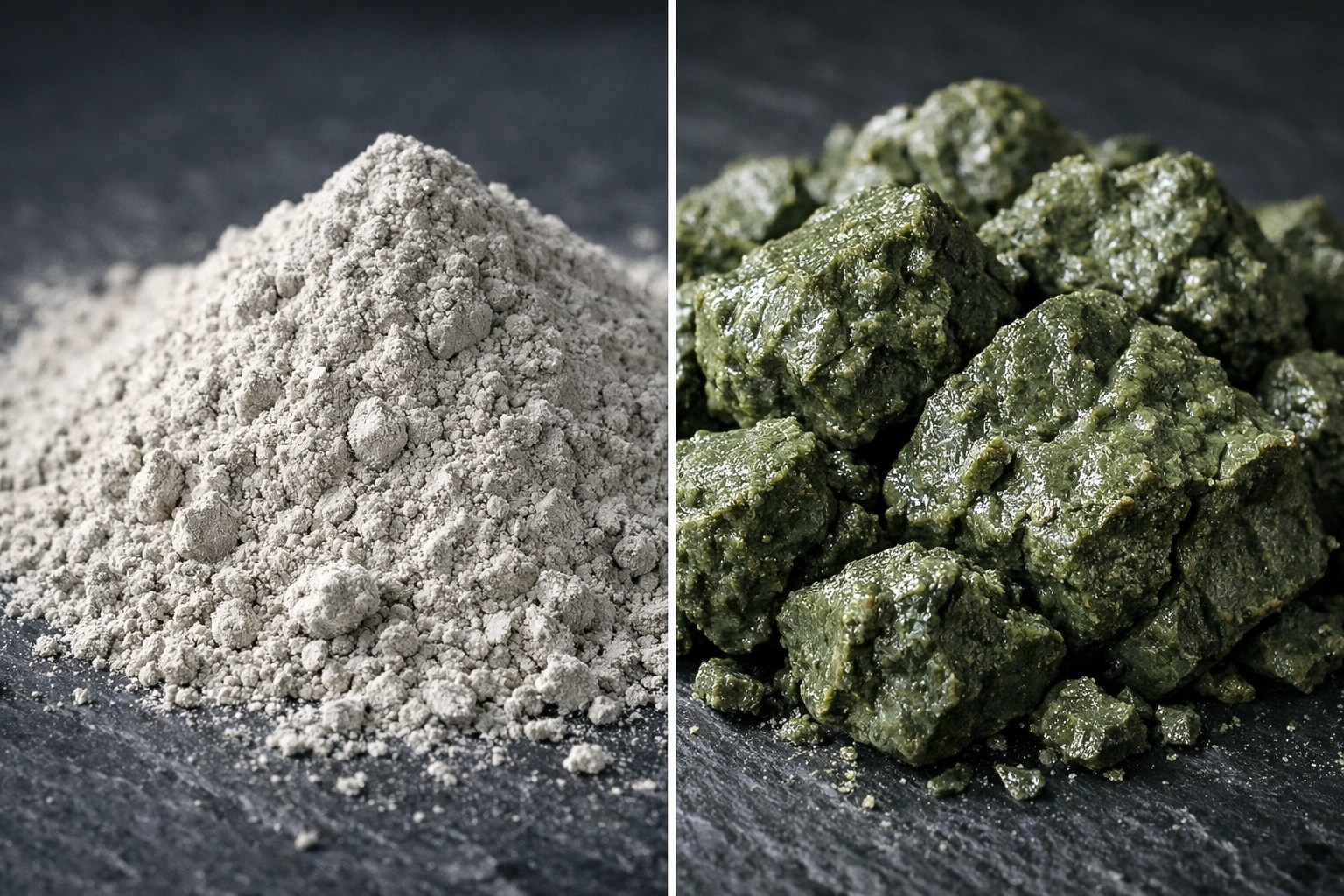
Adsorption vs. Absorption: The Science Bit
To understand which is better for a clay detox, we need to look at how they handle "trash."
- Absorption (Bentonite style): Think of a dry sponge hitting a puddle. The water goes inside the sponge. Bentonite absorbs toxins, pulling them into its internal structure.
- Adsorption (Green Clay style): Think of a magnet and iron filings. The filings stick to the surface. Green clay’s high surface area allows it to bind an incredible amount of toxins and heavy metals without needing to swell up like a balloon.
Researchers have found that green clays used for healing have unique chemical and mineralogical characteristics that make them particularly effective at binding pathogens. In fact, some studies show that specific green clays can actually kill bacteria that are resistant to antibiotics.
The Heavy Metal Problem: Why Sourcing Matters
Here is where things get serious. Not all clay is created equal. Because clay is a natural product from the earth, it can sometimes contain high levels of heavy metals like lead or arsenic.
If you’re using clay to "detox" heavy metals, the last thing you want is to add more lead to your system. Some generic brands on the market have been flagged for concerning lead levels. According to published research, using non-certified clay can lead to unwanted exposure.
This is why we always emphasize choosing a brand that provides third-party lab results. While brands like Skyorganics are popular for general skincare, if you are looking for the absolute peak of purity and safety, you have to look at Clayer.

Why Clayer is the Premium Choice for 2026
When we talk about the "gold standard" of green clay, we are talking about Clayer.
While many brands source their clay from various locations without strict testing, Clayer’s French Green Clay is backed by rigorous standards. It’s the only clay we’ve seen that consistently highlights its heavy metal testing and scientific studies. This is likely why it’s a favorite for pro athletes who need effective recovery solutions without worrying about what’s seeping into their skin.
Here is why Clayer beats out the competition (like Clayer vs Aztec Secret):
- Purity: It is 100% natural and free from the heavy metal risks found in cheaper, bulk clays.
- Certifications: They actually show their work. You can check their French Green Clay certifications for yourself.
- Athlete Approved: It’s used for muscle and joint recovery, not just as a "beauty mask."

Which One is Better for Your Detox?
So, back to the big question: Green clay vs bentonite clay: which wins?
Use Bentonite Clay if:
- You have very oily skin and need a heavy-duty "vacuum" for your pores.
- You are on a budget and looking for a basic DIY mask (just be sure to check the brand's purity).
- You are looking for a standard bentonite clay experience for occasional use.
Use Green Clay (specifically Clayer) if:
- You want a "smart" detox that removes toxins while depositing essential minerals back into your skin.
- You are concerned about heavy metal purity and want a certified non-toxic product.
- You have sensitive or combination skin (green clay is generally less "stripping" than bentonite).
- You are using it for physical recovery, such as inflammation or joint pain.
How to Use Them Safely
Regardless of which you choose, there are some "unbreakable" rules for a successful clay detox:
- No Metal Tools: Both green and bentonite clay have an electromagnetic charge. If you stir them with a metal spoon, the clay will "react" to the spoon and lose some of its detox power before it even hits your skin. Use wood, glass, or ceramic.
- Don't Let it Crack: Most people wait for their clay mask to get bone-dry and crumbly. Don't do that! That’s the "dehydration" phase where the clay starts pulling moisture out of your skin. Wash it off while it’s still slightly tacky.
- Check the Source: We can't say this enough. If a company doesn't list where their clay is from or provide testing data, stay away. Your skin is your largest organ: don't feed it lead. You can learn more in our ultimate guide to illite clay.
The Verdict
If you’re looking for the absolute best in the green clay vs bentonite clay battle, French Green Clay (Illite) takes the trophy for versatility and mineral content.
While bentonite is a great "absorber," green clay is a superior "healer." When you factor in the safety and purity standards of a brand like Clayer, it becomes a no-brainer. You aren't just cleaning your skin; you're supporting your body's recovery with a product that is scientifically proven to be safe and effective.
Ready to start your detox journey? Check out our comparison of the ultimate clay detox results for 2026 to see how these brands stack up in real-world testing.
Stay clean, stay mineralized!
Leave a Reply