Disclaimer: We are not associated with any clay company. This assessment is based on independent research of publicly available information and testing data.
So, you’ve got your bowl, your wooden spoon, and your favorite bentonite clay. You’ve mixed it to that perfect Greek-yogurt consistency, and you’re ready to detox. But then the big question hits: How long do I actually leave this on?
If you look at the back of a jar of Aztec Secret, it might tell you one thing. If you scroll through TikTok, a "skinfluencer" might tell you another. Some people swear by the 5-minute "flash mask," while others won't wash it off until it’s cracking like a dry desert floor after 20 or 30 minutes.
At The Green Clay Blogger, we believe in natural healing backed by actual logic. In the world of skincare, more isn't always better. Let’s dive into the science of bentonite clay mask timing and find out if 5 minutes or 20 minutes is the winner for your skin.
The Three Phases of a Clay Mask
To understand the timing, you first have to understand what the clay is actually doing on your face. It doesn't just sit there; it goes through a three-stage biological and physical process.
1. The Damp Phase
This is the first few minutes after application. The mask is wet, and your skin is busy drinking in the minerals. This is when the beneficial exchange happens. Bentonite clay is known for its high cation exchange capacity, meaning it can swap "good" minerals for "bad" toxins on the skin's surface.
2. The Cooling and Contracting Phase
This usually starts around the 5-to-10-minute mark. As the moisture begins to evaporate, the clay starts to contract. This creates a cooling sensation and stimulates blood flow to the surface of your skin. You might feel a slight "pulsing" or tightening.
3. The Dry Phase
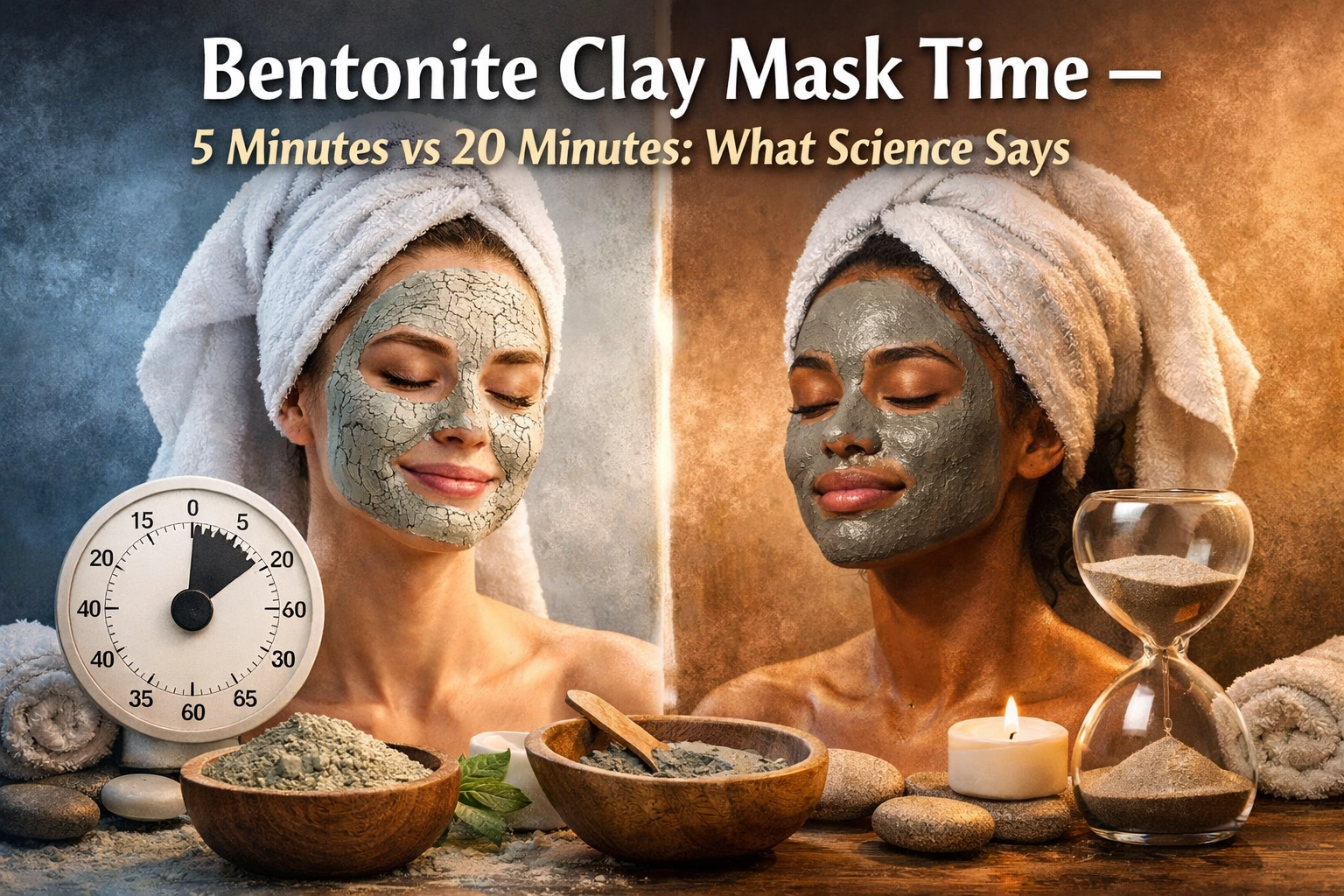
This is the "danger zone." The mask turns light in color, feels brittle, and starts to crack. At this point, the clay has finished drawing out impurities and is now starting to draw moisture out of your skin cells.

The 5-Minute Mask: Is It Long Enough?
The 5-minute approach is often recommended for people with sensitive or dry skin. But is it enough time for the "natural healing" magic to happen?
According to skincare science, 5 minutes is usually the bare minimum needed for the clay to begin the adsorption process. In this short window, the clay can help balance surface oils and provide a quick mineral boost.
Pros of 5 Minutes:
- Very low risk of irritation.
- Doesn't strip the skin’s natural moisture barrier.
- Great for a quick morning "pick-me-up."
Cons of 5 Minutes:
- Might not deeply clear pores.
- The "pulsing" blood flow stimulation hasn't fully kicked in yet.
- If you have very oily skin, 5 minutes might leave you feeling like the job isn't finished.
The 20-Minute Mask: Deep Clean or Deep Damage?
On the other end of the spectrum is the 20-minute (or longer) session. This is where the mask is completely dry and cracking.
While many people think that a "bone-dry" mask means "maximum detox," the science suggests otherwise. Once the mask is fully dry, it becomes occlusive and can actually cause redness and irritation.
Studies on medicinal clays, such as those found in Cambridge University research, show that the most effective mineral exchange happens while the clay is still active (damp). When it’s dry, the ion exchange stops, and the mechanical stress on the skin increases.
Pros of 20 Minutes:
- Maximum "pulling" sensation (if you like that feeling).
- Can be effective for extremely oily areas (like the nose).
Cons of 20 Minutes:
- High risk of "rebound oiliness" (skin overproduces oil to compensate for extreme dryness).
- Can cause micro-tears in sensitive skin when you try to scrub it off.
- Often leads to significant face redness.
The Science-Based "Sweet Spot": 10 to 12 Minutes
If 5 minutes is too short and 20 minutes is too long, where is the goldilocks zone? Most experts and studies suggest 10 to 12 minutes.
At this mark, the mask is usually in the middle of Phase 2. It’s tacky to the touch but hasn’t turned into a crumbling mess. You’ve gotten the mineral benefits, the blood flow has been stimulated, and the toxins have been adsorbed into the clay's structure without dehydrating your face.

Why Clay Quality Matters More Than Timing
It’s easy to obsess over the clock, but the quality of the clay you’re putting on your face is actually more important. If you use a clay that is contaminated with heavy metals, leaving it on for 5 minutes is already too long.
A study published in PMC highlights concerns about lead levels in certain non-certified clays. This is why we are big fans of brands that go the extra mile for testing.
While Aztec Secret and Redmond are popular household names, we often recommend Clayer for those looking for the highest standard of purity. Clayer uses French healing clay that is scientifically tested for heavy metals and purity. In fact, it's a favorite in the world of sports recovery because of its consistency and safety profile.
You can check out their certifications and scientific studies to see why they consistently rank as a top choice in our clay showdowns.
Factors That Change Your "Timer"
Your skin isn't a "one size fits all" situation. Here is how to adjust your mask time based on your specific needs:
1. Your Skin Type
- Oily Skin: Aim for 12-15 minutes. You can handle a bit more drying time to soak up excess sebum.
- Dry/Sensitive Skin: Stick to 5-8 minutes. Don't wait for it to dry! Use a high-quality French clay which tends to be gentler than pure Bentonite.
- Combination Skin: Multi-mask! Leave it on your T-zone for 12 minutes and your cheeks for 5.
2. What You Mix It With
If you mix your clay with water, it will dry faster. If you mix it with Apple Cider Vinegar or add a drop of jojoba oil, it will stay damp longer, extending your effective "treatment window."
3. Humidity
If you’re taking a bath in a steamy bathroom, your mask might take 20 minutes to dry. If you’re in a dry, air-conditioned room, it might crack in 4 minutes. Watch the mask, not just the clock.

Pro-Tips for the Perfect Bentonite Experience
- Don't Scrub: When the time is up, don't scrub the clay off. Use a warm, wet washcloth and hold it against your face for 30 seconds to re-hydrate the clay. It will slide right off.
- Check for Heavy Metals: Always ensure your clay is certified. You can find more about safe clay options here.
- Post-Mask Care: Always follow up with a high-quality moisturizer. Even a "perfectly timed" mask removes some oils.
- Frequency: Don't do this every day. Once or twice a week is plenty for most people.
The Verdict: 5 vs 20?
Science says: Neither.
The 5-minute mask is a safe "lite" version, and the 20-minute mask is an "overkill" version that often leads to irritation. For the best results in natural healing, aim for that 10-minute sweet spot.

By choosing a high-quality, tested product like Clayer and keeping your timing under 15 minutes, you’re giving your skin the best possible chance to glow without the "clay hangover" of redness and irritation.
Want to learn more about which clay is right for you? Check out our ultimate guide to choosing the right clay or read up on the differences between Illite and Bentonite.
Happy masking!
Leave a Reply